
The Covenant Cut in Blood
Entering the Ancient World Behind God’s Promise to Abraham
The Covenant Cut in Blood
Entering the Ancient World Behind God’s Promise to Abraham
SERIES:
read state
Updated:
Stepping Into the Ancient World of Covenant
Covenant is one of the most important themes in Scripture, yet for many modern readers it feels distant and unfamiliar. When we hear “promise” or “agreement,” our minds go to contracts, signatures, and legal terms. But in the ancient Near Eastern world, covenant was nothing like that. It was not casual. It was not symbolic. It was not reversible.
A covenant was life itself.
In Genesis 15, God does something so shocking and so deeply rooted in the ancient world that without understanding the cultural and historical context, we miss the weight of the entire moment. God does not simply reassure Abraham with kind words. He initiates a ritual so serious that it carried only two possible outcomes. Faithfulness or death.
📝 This is why we must understand the world Abraham lived in. If we do not grasp the meaning behind “cutting a covenant,” we will never fully grasp what God was revealing or why it matters for the cross.
What It Meant to Cut a Covenant
In English Bibles we read that God promised to “make a covenant.” But in Hebrew, the text says that God would cut a covenant. This was literal language. Bloodshed was not a symbolic gesture. It was the very mechanism by which a covenant was created.
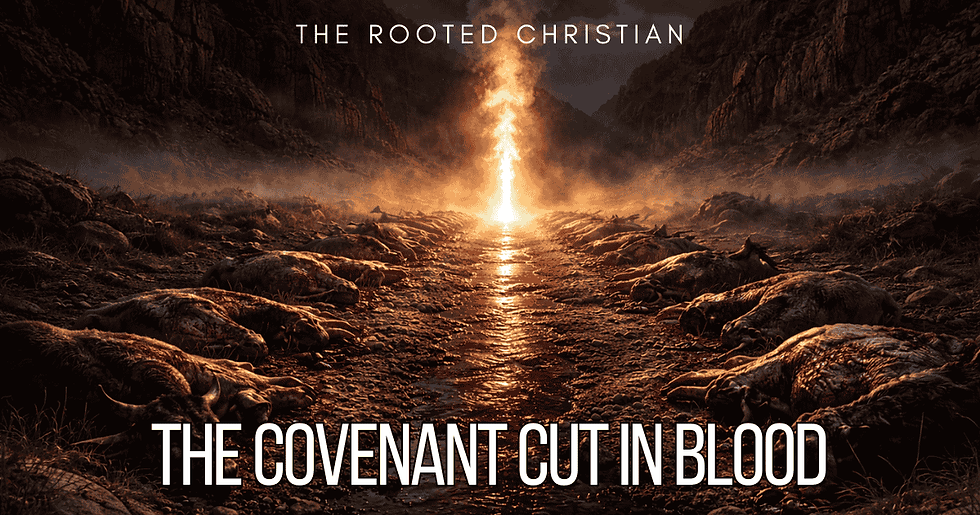
To cut a covenant, two parties slaughtered animals, divided the carcasses, and laid the pieces in two parallel rows. The blood would form a path between them. Then the lesser party walked through the pieces, reciting the terms of the covenant, declaring essentially:
“May what has happened to these animals happen to me if I break this covenant.”
The cost of covenant breaking was death. Not metaphorical death. Real death.
📝 Ancient readers would have understood this ritual immediately. It was a public declaration of loyalty unto death. It was irreversible. It was binding. And it was always the lesser party who walked between the pieces.
This is precisely why what happens in Genesis 15 is so astonishing.
Abraham’s Fear and God’s Response
Before the ritual begins, Genesis paints a sobering picture of Abraham’s internal state. He is a man with promises but no fulfillment. He is aging. He has no heir. And he wonders how God will do what He said He would.
God responds not with rebuke but with reassurance.
1 After these things the word of the LORD came to Abram in a vision: “Fear not, Abram, I am your shield; your reward shall be very great.” (ESV)
But Abraham still wrestles with uncertainty. He asks for clarity. He asks how he can know that God will keep His word. This is not rebellion. It is the cry of a man trying to understand the character of the God who called him.
So God answers not with mere words but with a covenant ceremony. He invites Abraham into an ancient ritual whose meaning no one in that world would have misunderstood.
But then something unexpected happens.
The Shocking Instruction: Prepare the Animals
9 He said to him, “Bring me a heifer three years old, a female goat three years old, a ram three years old, a turtledove, and a young pigeon.” (ESV)
Anyone in Abraham’s day would have instantly recognized what God was about to do. This is covenant language. This is the ritual of cutting a covenant. Abraham knew exactly what came next.
He slaughtered the animals.
He arranged the pieces.
He created the blood path.
Abraham would have fully expected to walk between those pieces. That was the standard. That was the expectation. That was the role of the lesser party.
God had asked for the setup. Abraham prepared it. The ritual was ready.
But the moment Abraham was supposed to take his first step, the narrative takes a turn that appears nowhere else in all ancient Near Eastern literature.
Why God Chose a Visual, Bloody Covenant
God could have repeated His promise. He could have reassured Abraham verbally. He had done so before. Instead, He chose a covenant ritual that was unmistakably serious, tangible, and unforgettable.
Why?
Because God wanted Abraham to see with his own eyes what kind of God He is. He wanted to anchor Abraham’s faith in something deeper than memory or hope. He wanted to tie His promise to a ritual so intense that Abraham would never be able to question God’s commitment again.
📝 God does not perform meaningless rituals. Every movement in Genesis 15 is intentional, prophetic, and foundational for understanding the cross.
This covenant is not about Abraham proving his loyalty. It is about God proving His.
When the Ritual Points Beyond Itself
We cannot read Genesis 15 in isolation. This moment sits on the spine of the entire biblical narrative. What God begins here travels through Moses, David, the prophets, the exile, the return, and ultimately the person of Jesus Christ.
The covenant cut in Genesis 15 is not a forgotten ritual. It is the very foundation of the gospel itself.
God is not simply making a promise. He is binding Himself to the destiny of Abraham’s descendants in a way that will require Him to do the unthinkable centuries later.
This is why understanding covenant is essential. It reveals that the cross was not a divine improvisation. It was the fulfillment of the oath God made with Abraham long before Israel even existed.
And the turning point of the entire covenant ceremony happens not when Abraham walks the pieces, but when God prevents him from walking at all.
That moment is the focus of Part 2.
Final Thought
Genesis 15 is not just an ancient ritual. It is the blueprint of redemption. God invites Abraham into a familiar covenant structure only to radically transform it. Before Abraham can act, God reveals that this covenant will not depend on human strength or human faithfulness. It will depend solely on God Himself.
Understanding what it meant to “cut a covenant” is the first step to understanding the cross. God does not ask Abraham to take the blood path because God has already decided that He will be the One who walks it.
Ask Yourself:
What assumptions have I made about God’s promises that come from modern thinking rather than biblical covenant?
Do I recognize the seriousness and beauty of a God who binds Himself to His people in blood?
How does understanding ancient covenant change the way I read the story of salvation?
Join the Discussion:
Why do you think God chose a bloody, visual ritual instead of a simple verbal promise?
#TheWholyChristian #TheRootedChristian #BibleTheologyAndApologetics #FaithAndSpiritualGrowth #HistoryAndCivilizations #WalkingThePieces #AbrahamicCovenant #Genesis15