
Same Hearts, Different Tools: Why Modern Life Isn’t New, Just More Convincing

Updated: Feb 19
How technology amplifies ancient rebellion and quietly teaches us to trust man instead of God
Most people today genuinely believe they live in a completely different world than the people in the Bible. Not just different technologically, but different mentally and spiritually. We hear things like, “They didn’t know what we know,” “They didn’t have science,” or “They didn’t understand the world like we do now.” And on the surface, that feels reasonable.
We’ve got electricity, modern medicine, satellites, instant communication, and more information in our pockets than kings once had access to in entire libraries. We can see storms coming days in advance. We can map the human genome. We can talk to someone on the other side of the earth instantly, face to face.
But when you strip all of that away, modern life is spiritually identical to biblical life.
The desires are the same.
The fears are the same.
The temptations are the same.
The rebellion is the same.
The only real difference is the tools we use to interact with the world, and how convincing those tools have become at replacing our need for God.
Humanity Has Always Been Advanced, Not Primitive
One of the biggest lies modern culture tells is that ancient people were basically ignorant cavemen who needed God because they didn’t know any better. That narrative conveniently makes modern humanity feel superior and quietly reframes faith as something we’ve evolved past, like training wheels we no longer need.
Scripture doesn’t support that idea at all.
From the very beginning, humanity is shown as creative, intelligent, skilled, and innovative.
📜 Genesis 4:20–22
“Adah bore Jabal; he was the father of those who dwell in tents and have livestock. His brother’s name was Jubal; he was the father of all those who play the lyre and pipe. Zillah also bore Tubal-cain; he was the forger of all instruments of bronze and iron.”
This passage is easy to skim past, but it’s doing something important. It’s showing us that early humanity didn’t slowly stumble into progress over thousands of years. They developed agriculture, animal husbandry, music, art, metallurgy, and toolmaking very early on.
That requires planning.
Experimentation.
Skill.
Knowledge.
Intelligence.
These weren’t dumb people waiting to be enlightened by modern science. They were builders, artists, engineers, and innovators just like us.
So right out of the gate, Scripture dismantles the idea that modern humans are the first “advanced” generation.
📝 The Bible never presents progress itself as evil. It consistently presents misplaced trust as the problem.
The issue has never been knowledge. It’s been what people do with knowledge and who they rely on because of it. Capability has always existed. The danger begins when capability turns into confidence, and confidence turns into independence from God.
The Tower of Babel Wasn’t About Height, It Was About Independence
When people think about the Tower of Babel, they usually imagine arrogance in the sense of “we want to reach heaven.” But that’s not actually the heart of the story. The deeper problem is far more familiar to modern life.
📜 Genesis 11:3–4
“And they said to one another, ‘Come, let us make bricks, and burn them thoroughly.’ And they had brick for stone, and bitumen for mortar. Then they said, ‘Come, let us build ourselves a city and a tower with its top in the heavens, and let us make a name for ourselves, lest we be dispersed over the face of the whole earth.’”
Pay attention to the language being used.
Let us make.
Let us build.
Let us make a name.
Let us secure ourselves.
This wasn’t rebellion through immorality. It was rebellion through self-sufficiency.
God had already told humanity to spread out and fill the earth. Babel says, “We won’t. We’ll secure ourselves instead.” They weren’t denying God’s existence. They were deciding He wasn’t necessary.
📝 Babel is the first recorded moment where technology, unity, and organization are used to replace obedience and trust in God.
That’s why God intervenes. Not because building is bad, and not because technology is sinful, but because independence from Him always leads to destruction, even when it looks impressive and responsible.
Modern society is Babel amplified. We build systems for everything so we don’t have to rely on God. Financial systems so we don’t have to trust Him for provision. Medical systems so we don’t have to confront mortality. Entertainment systems so we don’t have to sit with our thoughts, guilt, or convictions.
It all feels wise.
It all feels safe.
And it all quietly trains independence.
Technology Has Become the New Provider
Scripture constantly warns about trusting in human strength and systems instead of God. That warning didn’t expire when society became more advanced.
📜 Psalm 20:7
“Some trust in chariots and some in horses, but we trust in the name of the Lord our God.”
In biblical times, chariots and horses were cutting-edge military technology. They represented security, power, and control. Trusting in them meant believing human strength could guarantee safety instead of relying on God’s protection.
Today, the “chariots and horses” just look different. They’re technology, medicine, data, algorithms, insurance policies, financial systems, and institutions.
📝 The object of trust changes with culture, but the heart posture never does.
We’ve been trained to believe almost every problem can be solved without God. Hungry? There’s food delivery. Lonely? There’s social media. Anxious? There’s medication. Afraid? There’s surveillance, locks, and systems.
None of those things are evil by themselves. The danger is that they quietly replace prayer, patience, and reliance on God. We don’t stop believing in Him. We just stop needing Him.
Conformity Doesn’t Feel Like Rebellion Anymore
This is where Scripture becomes painfully relevant to modern life, because the danger Paul is warning about isn’t obvious sin. It’s subtle reshaping.
📜 Romans 12:2
“Do not be conformed to this world, but be transformed by the renewal of your mind, that by testing you may discern what is the will of God, what is good and acceptable and perfect.”
When Paul talks about being “conformed,” he’s describing the idea of being pressed into a mold. Shaped gradually. Adjusted over time until resistance disappears. That’s important because conformity doesn’t feel like rebellion. If it did, most people would push back immediately.
Conformity feels normal.
It feels reasonable.
It feels responsible.
You don’t wake up one day and decide to reject God. You slowly adopt the world’s assumptions about what matters, what’s urgent, what’s realistic, and what’s outdated. You start thinking the same way, evaluating life the same way, measuring success the same way.
That’s why Paul connects conformity to the mind. This isn’t about behavior first. It’s about worldview. About how you process reality and decide what’s true.
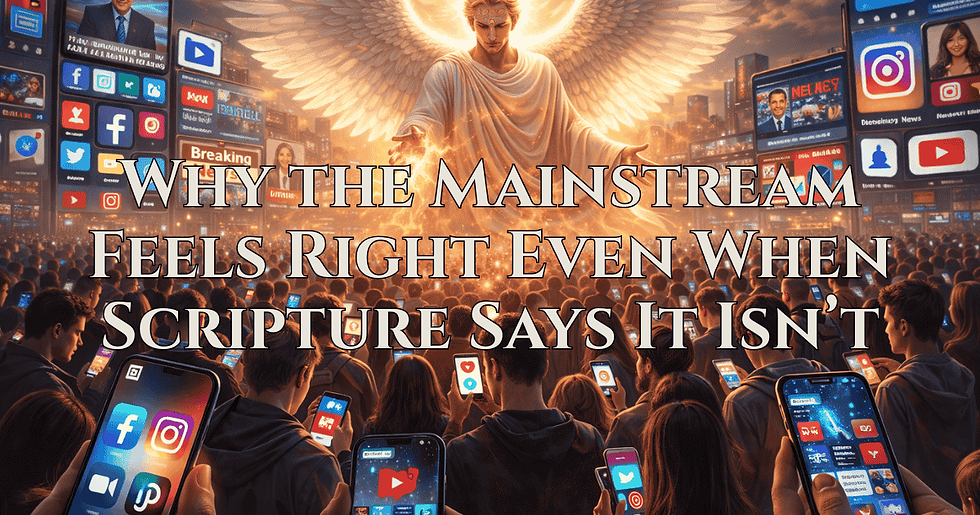
Modern conformity happens through constant exposure. Endless messaging that tells you what matters and what doesn’t. What’s “backward.” What’s “progress.” What’s “common sense.” What’s “extreme.”
📝 The world no longer has to argue against God. It just trains people to live as if He’s unnecessary.
Technology makes this incredibly effective because it doesn’t demand agreement. It immerses you until the world’s values feel self-evident. You don’t feel pressured. You feel informed. You feel modern. You feel balanced.
And that’s exactly why Paul says transformation requires renewal. If the mind isn’t intentionally renewed by Scripture, it will be quietly conformed by the world.
The Lie of Progress and the Death of Dependence
Modern culture is built on the idea of progress. We’re told humanity is evolving, improving, and maturing past old religious frameworks. Faith is treated like a temporary support system that we no longer need now that we’ve figured things out.
Scripture doesn’t buy that narrative at all.
📜 1 Corinthians 1:20
“Has not God made foolish the wisdom of the world?”
Paul isn’t saying intelligence is bad or that learning is sinful. He’s saying that human wisdom, when separated from God, always turns inward. It always ends with humanity crowning itself as the final authority.
That’s why modern wisdom so often leads to pride instead of humility. We don’t just learn more; we start believing we know better — better than past generations, better than Scripture, better than God Himself.
This is where “progress” becomes spiritually dangerous. It convinces people that dependence is weakness and that maturity means self-sufficiency.
That’s why modern spirituality sounds so familiar when you compare it to the earliest pages of the Bible.
📜 Genesis 3:5
“You will be like God.”
That was the original temptation. Not open rebellion, but autonomy. The promise that humanity could define good and evil for itself. That dependence on God was no longer necessary.
📝 Modern spirituality doesn’t introduce new truth. It repackages ancient rebellion using softer, more appealing language.
Instead of denying God outright, it absorbs Him into the self. God becomes internal, symbolic, or optional. Truth becomes personal. Obedience disappears. Repentance feels outdated.
And once dependence is gone, submission goes with it. Progress doesn’t lead people closer to God; it often convinces them they’ve outgrown Him.
Technology Isn’t Evil, But It Is Formative
This is where many Christians underestimate the issue. We tend to frame technology as morally neutral... ‘It's just tools we use for good or bad.’ Scripture takes formation far more seriously than that.
Technology absolutely can be used for God’s purposes. The gospel can spread faster than ever. Teaching can reach places missionaries can’t. Community can exist across distance and hardship.
But technology is never neutral because it doesn’t just serve us. It trains us.
It shapes attention by fragmenting it.
It trains impatience by eliminating waiting.
It rewards distraction by offering constant stimulation.
It makes silence uncomfortable by filling every gap.
📝 What shapes your habits will eventually shape your heart.
Scripture calls believers to stillness, meditation, waiting, endurance, and trust. Technology trains the opposite instincts: speed, reaction, efficiency, control.
So when Scripture and prayer get squeezed into leftovers while technology dominates attention, formation is already happening whether we admit it or not. God isn’t being rejected. He’s being crowded out.
And over time, what starts as convenience becomes conditioning.
The Real Divide Has Always Been the Same
When everything is stripped away, the difference between biblical life and modern life isn’t intelligence, innovation, or progress.
It’s trust.
📜 Jeremiah 17:5
“Cursed is the man who trusts in man and makes flesh his strength, whose heart turns away from the Lord.”
That verse isn’t condemning tools, systems, or progress. It’s condemning misplaced trust. The moment human solutions become the first instinct instead of God, something shifts internally.
Notice the language: whose heart turns away from the Lord. This isn’t about atheism. It’s about reliance. Direction. Instinct.
📝 Whenever human solutions replace reliance on God, hearts drift. Even while life looks successful.
That’s why modern life can look stable, advanced, and prosperous while still being spiritually hollow. Trust has shifted. Dependence has faded. God hasn’t been denied, He’s been displaced.
And Scripture has been warning about that from the beginning.
Final Thought
Modern life hasn’t outgrown God. It’s just become better at convincing people they don’t need Him. The same ancient temptation is still at work: trust what you can build, control, and improve. Trust yourself.
Technology didn’t create that lie. It just made it louder, faster, and harder to escape.
For true Christians, the call isn’t to reject technology, but to refuse its discipleship. To remain dependent. To slow down. To pray when the world says “optimize.” To trust God when man-made systems promise certainty.
Ask Yourself:
Where has technology quietly replaced prayer or dependence on God in my life?
What comforts or systems do I trust instinctively before I trust the Lord?
Am I being shaped more by Scripture or by the world’s constant messaging?
Join the Discussion:
How do you personally guard your dependence on God in a world designed to eliminate the need for Him?


Comments